
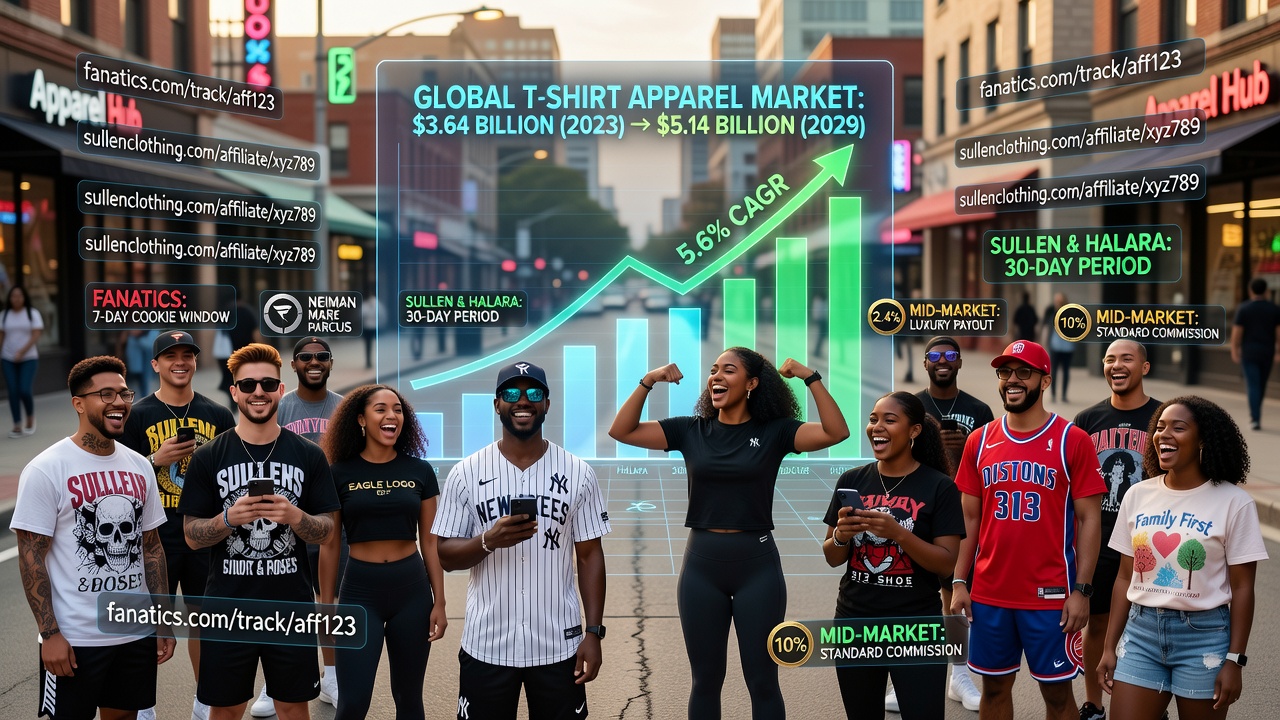
The global t-shirt market is on a steady upward climb, moving from roughly $3.64 billion in 2023 toward an estimated $5.14 billion by 2029, a 5.6% compound annual growth rate. That expansion has made apparel one of the more active categories in affiliate marketing, drawing everything from licensed sports merchandise sellers to niche streetwear labels into the business of paying commissions for referred sales.
Why Apparel Affiliate Programs Are Multiplying
Clothing sits in an unusual position for affiliate marketers: purchase decisions are frequent, emotionally driven, and often tied to identity - team loyalty, subculture, or lifestyle branding. That combination tends to produce higher conversion rates than more considered purchases, which is partly why retailers across very different niches, from Fanatics' licensed sports gear to Sullen Clothing's tattoo-inspired streetwear, run comparable commission-based referral schemes. The underlying mechanics are simple: an affiliate shares a tracked link, a customer buys within a set cookie window, and the retailer pays a percentage of the sale.
Commission rates in this space vary meaningfully. Programs reviewed here range from around 2.4% at the luxury end, where Neiman Marcus sells high-ticket designer goods with naturally higher average order values, up to 10% for mid-market family and lifestyle brands like Jane Preferred. That spread reflects a basic trade-off in affiliate economics: lower-margin luxury goods often pay smaller percentages because the absolute dollar commission is still substantial, while mass-market apparel brands compensate for slimmer order values with higher percentage payouts.
Cookie Windows and Payout Structures Matter More Than Headline Rates
A commission percentage alone tells only part of the story. Cookie duration - the window during which a sale is still credited to an affiliate after a click - shapes real earning potential just as much as the rate itself. Among the programs covered, durations range from 7 days (Fanatics) to 30 days (Pistons 313 Shop, Sullen Clothing, Halara), meaning a shopper who browses, leaves, and returns weeks later can still generate a commission under the longer-window programs but not under shorter ones.
- Shorter cookie windows suit impulse-driven categories like licensed sports gear tied to live events.
- Longer windows benefit considered purchases, such as family apparel or activewear, where buyers compare options before committing.
- Average order value, not just commission percentage, determines actual per-sale earnings - a 2.4% rate on a $200 purchase can outearn a 10% rate on a $20 item.
What This Growth Means for Affiliates and Consumers
For affiliate marketers, the sector's growth trajectory signals continued opportunity, but also increasing competition as more apparel brands build out referral infrastructure to capture a slice of that $5.14 billion projected market. Differentiation will likely come down to audience fit - a tattoo-culture brand like Sullen or a streetwear name like BOY London depends on affiliates reaching the right niche rather than broad, generic traffic.
For consumers, the expansion of affiliate-driven retail means more product discovery through creators, bloggers, and niche sites rather than traditional advertising alone. That shift places added weight on transparency: reputable programs disclose commission relationships, and buyers benefit when affiliates are clear about sponsored or incentivized recommendations rather than presenting them as neutral advice.