
Roughly one in five withdrawal requests at online casinos gets delayed or flagged for additional review. That single statistic explains why so many players end up confused, frustrated, or convinced they've been cheated when, in fact, they've simply run into standard verification procedures. The gap between what players expect and what operators actually require is where most complaints, myths, and genuine scams take root.
This guide addresses that gap directly. Payment systems, identity checks, deposit limits, licensing jurisdictions, and dispute procedures are not exciting topics on their own, but they determine whether your money is safe and whether you get paid when you win. One example worth understanding early is valor paybill, a mobile-based payment channel some regional operators use to process deposits and withdrawals; players who research the mechanics of tools like valor paybill before depositing tend to avoid the confusion that hits those who don't. The same logic applies to everything else covered here.
What follows is a practical breakdown of how legitimate operators handle your money and your data, how to protect yourself from predatory practices, and what to do when something goes wrong - whether that's a malfunctioning slot, a rejected withdrawal, or a "guaranteed win" tip that turns out to be a con.
Understanding Valor Paybill and How Payment Verification Works
What Is Valor Paybill
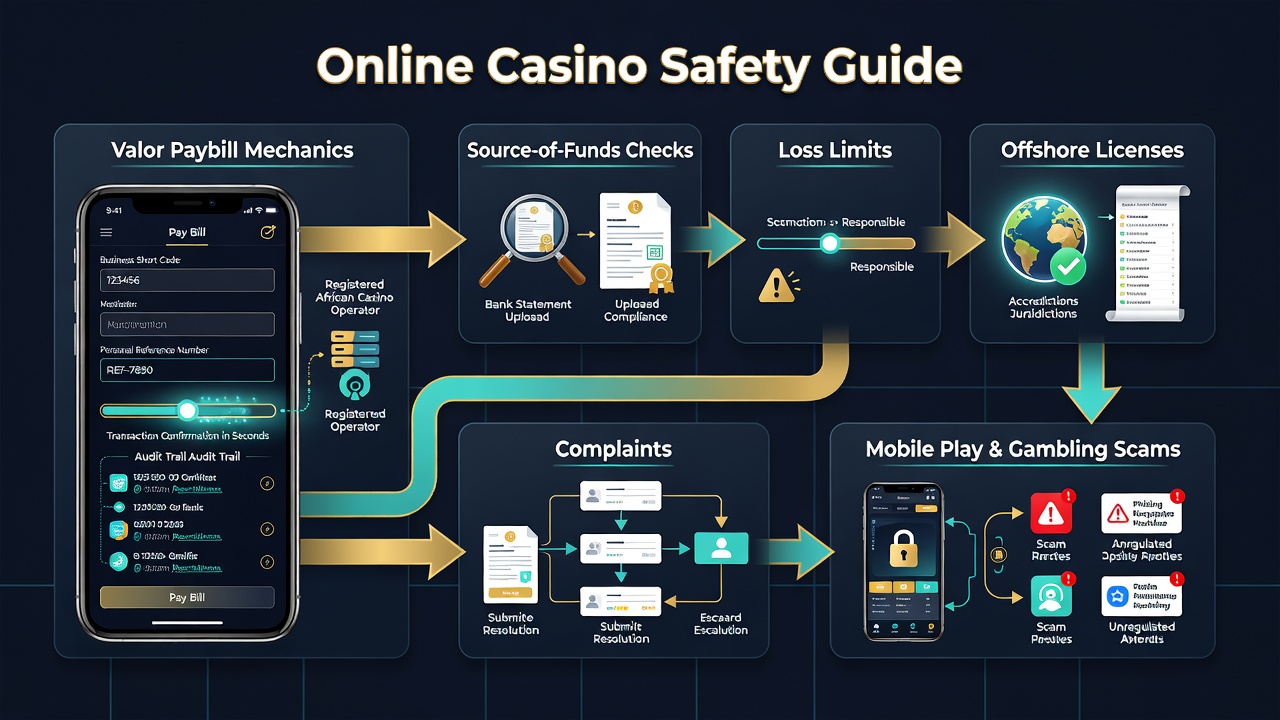
Valor paybill is a payment reference system used by certain online casinos operating in African markets, particularly those integrating with mobile money networks. Rather than entering card details, players use a paybill number and a personal account reference to deposit funds through their mobile banking app. It functions similarly to utility bill payments - you're sending money to a business short code rather than a private account, which adds a layer of traceability that benefits both the operator and the player.
How Does Valor Paybill Work
The mechanics are straightforward. A player logs into their online banking or mobile money app, selects the "pay bill" option, enters the casino's designated business number, then inputs their own account ID or phone number as the reference code. The transaction confirms within seconds, and the casino's system matches the reference number to the correct player account automatically. Because the paybill number belongs to a registered business entity rather than an individual, transactions are easier to audit - which matters if a dispute over a missing deposit ever arises.
Why Payment Traceability Matters for Safety
Payment methods that leave a clear audit trail protect players more than they inconvenience them. When a deposit method routes through a verifiable business account, both the bank and the casino can confirm exactly when and how much was transferred. This becomes critical if a dispute over a missing deposit or delayed withdrawal ever reaches a regulator or payment provider.
Source-of-Funds Verification: Why Casinos Ask Where Your Money Comes From
What Is Source of Funds Verification in Casinos
Source-of-funds verification is a compliance check where an operator asks a player to prove that deposited money comes from legitimate income - a salary, business earnings, investment returns, or savings. Licensed casinos are legally obligated to run these checks under anti-money-laundering regulations, particularly once a player's deposits or winnings cross certain thresholds. It is not an accusation of wrongdoing; it's a standard control that regulated financial and gambling businesses must apply to everyone eventually.
When and Why These Checks Get Triggered
Verification requests typically appear after a large single deposit, a sudden spike in betting volume, or before a substantial withdrawal is released. Casinos ask for documents such as payslips, bank statements, or tax records. Players who ignore these requests risk frozen accounts, because the operator cannot legally release funds without confirming their origin.
Documents Players Should Prepare in Advance
- Recent bank statements showing deposit history
- Payslips or employment contracts
- Screenshots of other payment platforms used to fund the account
- Tax returns or business registration documents, if self-employed
Having these ready before a big withdrawal cuts delays from weeks down to days.
Loss Limits and Responsible Play Tools
How to Set Loss Limits on Online Gaming Platforms
Most licensed casinos include a responsible gambling dashboard, usually found in account settings, where players can set daily, weekly, or monthly deposit and loss caps. Once a limit is set, the platform blocks further deposits or wagers automatically once the threshold is reached, regardless of how the player feels in the moment. Some platforms enforce a cooling-off period - typically 24 to 48 hours - before a limit can be raised, which prevents impulsive reversals mid-session.
Why Chasing Losses Is Dangerous in Gambling
Chasing losses - increasing bets or continuing to play specifically to recover money already lost - is the single most common pattern behind serious gambling harm. It distorts decision-making because the goal shifts from entertainment to recovery, and recovery-driven betting almost always involves larger, riskier wagers than a player would normally accept. The mathematics of house edge guarantee that chasing losses over an extended session statistically increases total losses rather than reversing them.
Building a Personal Bankroll Strategy
A workable strategy starts before the first deposit: decide on a fixed entertainment budget, treat it as spent the moment it's deposited, and never fund gambling with money earmarked for bills or savings. Pairing this mindset with the platform's built-in loss limits creates a practical safety net that doesn't rely on willpower alone.
Offshore Licenses and What They Actually Mean
What Is an Offshore Casino License
An offshore casino license is a gambling permit issued by a jurisdiction outside the operator's primary market - common examples include Curaçao, Malta, the Isle of Man, and Kahnawake. These jurisdictions license operators to serve international players, often with lighter regulatory overhead than licenses issued for domestic markets like the UK or parts of the EU. Holding an offshore license doesn't automatically mean a casino is unsafe, but the strength of consumer protection varies significantly between issuing authorities.
How to Check If a License Is Legitimate
Every legitimate license number can be verified directly on the regulator's official website. Players should cross-check the license number displayed in a casino's footer against the regulator's public database rather than trusting the number at face value, since fake license badges are a common trick used by fraudulent sites.
Differences Between Strict and Lenient Jurisdictions
Regulators like Malta's Gaming Authority or the UK Gambling Commission require rigorous financial audits, mandatory dispute resolution services, and strict advertising rules. Others issue licenses with minimal ongoing oversight. This difference explains why two casinos can both claim to be "licensed" while offering vastly different levels of player protection.
Filing Complaints Against Online Operators
How to File a Complaint Against an Online Operator
The first step is always internal: submit a written complaint directly to the casino's support team and request a formal case number. If that doesn't resolve the issue within the operator's stated timeframe, escalate to the licensing authority listed in the casino's footer - most regulators maintain a public complaints portal for exactly this purpose. Independent dispute mediators, which many licensed casinos are contractually required to cooperate with, offer a further route when direct escalation stalls.
What Evidence to Collect Before Escalating
- Screenshots of the disputed transaction or game round
- Full email or chat correspondence with support
- Account statements showing deposit and withdrawal history
- Terms and conditions in effect at the time of the dispute
Regulators move faster when a complaint arrives organized and documented rather than as a narrative account alone.
Realistic Timelines for Resolution
Internal casino complaints are often resolved within a week or two. Regulatory escalations take longer - sometimes a month or more - because investigators need to request records from the operator before making a ruling.
Mobile Play, Instant Access, and Common Scams
What Is Instant Play Casino in Mobile Browser
Instant play refers to casino games that run directly inside a mobile browser without requiring an app download. The games load through HTML5 technology, meaning they work on virtually any smartphone regardless of operating system. This format has largely replaced native apps for casual players because it removes storage concerns and update requirements while still offering full access to slots, table games, and live dealer tables.
Are Guaranteed Win Betting Tips Always Scams
Any tip promising a guaranteed outcome in a game governed by random number generation or fixed house odds is misrepresenting how the product works. Legitimate tipsters and analysts can improve the probability of informed decisions in sports betting through statistics, but "guaranteed" wins on casino games specifically are mathematically impossible to promise, since outcomes are generated independently of any external strategy. Sellers of these tips typically profit from subscription fees, not from the betting advice actually working.
What to Do If a Casino Game Malfunctions Mid-Spin
Stop playing immediately and take a screenshot or screen recording of the frozen or glitched screen before refreshing anything. Contact live support right away, reference the exact time and game round, and request a written incident log. Reputable operators have a documented malfunction policy - usually stating that a malfunction voids the specific play in question - and will honor legitimate wins that were clearly displayed before the glitch occurred, provided there's evidence.
Recognizing Fake or Cloned Casino Sites
Scam sites frequently copy the branding of legitimate operators, changing only the domain slightly. Checking the URL carefully, confirming SSL encryption, and verifying the license number independently are the three fastest ways to avoid depositing into a cloned platform.
Frequently Asked Questions
Is it normal for a casino to ask for ID after I've already deposited money several times?
Yes. Verification often triggers based on cumulative deposit volume or before a large withdrawal, not necessarily at signup. This is standard compliance practice under most licenses, not a sign that something is wrong with your account.
Can I get my money back if a slot freezes right when I hit a big win?
If you have a screenshot or recording showing the win before the freeze, and the operator's malfunction policy supports voided-but-verifiable outcomes, you have a strong basis for a claim. Contact support immediately and escalate to the regulator if the casino refuses to review the evidence fairly.
Why do some offshore-licensed casinos still refuse to pay out?
Weaker regulatory jurisdictions impose fewer financial audits and less strict enforcement, which means some operators exploit the gap in oversight. Checking the regulator's dispute-resolution track record before depositing significant money reduces this risk considerably.
Does setting a loss limit affect my account's VIP or loyalty status?
No. Responsible gambling tools are separate from loyalty programs and do not affect bonus eligibility, VIP tier progress, or promotional offers. Any casino that penalizes a player for setting limits is violating standard responsible gambling obligations.
How long does source-of-funds verification usually take once documents are submitted?
Most licensed operators process source-of-funds documentation within three to ten business days, though complex cases involving multiple income sources can take longer. Submitting clear, complete documents on the first attempt is the biggest factor in speeding up the timeline.
What's the safest way to deposit money at an online casino for the first time?
Start with a small test deposit using a traceable, verifiable payment method rather than the maximum amount you're willing to spend. This lets you confirm withdrawal speed and support responsiveness before committing larger sums.