
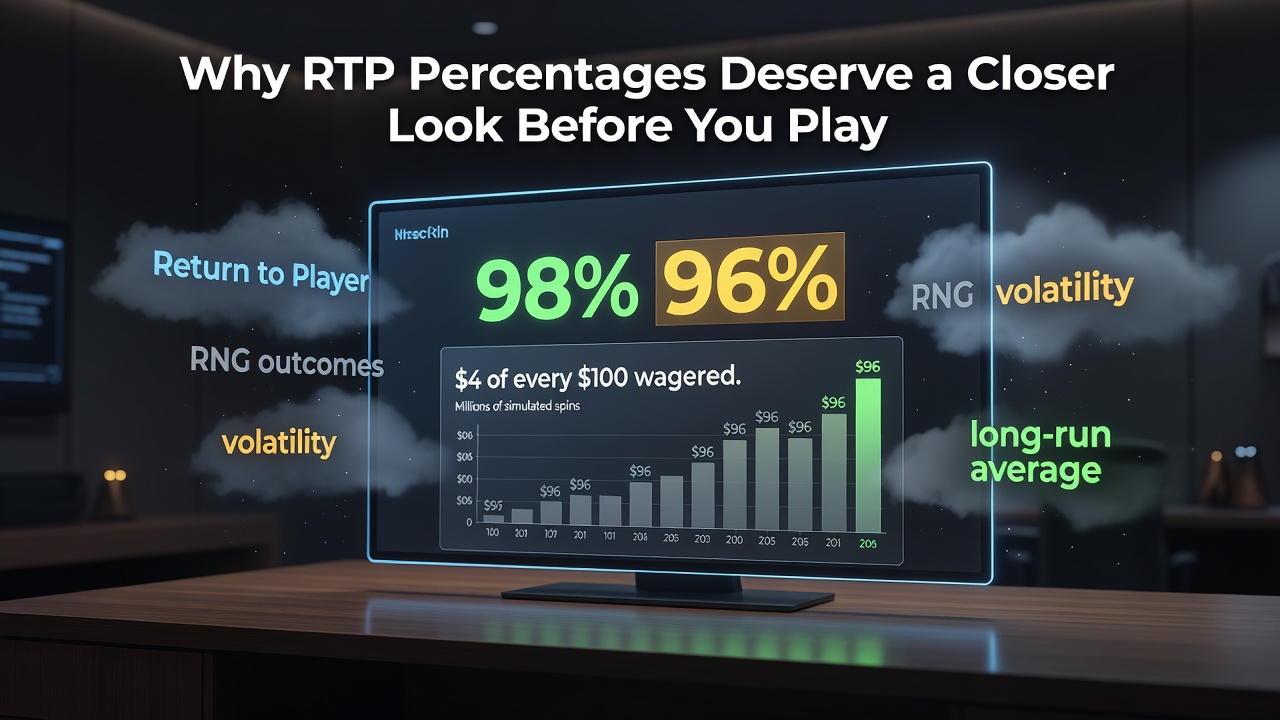
A two-point gap between a 98% payout rate and the industry's 96% baseline sounds trivial until you run the math across thousands of spins. Return to Player, or RTP, is the single figure that quantifies how a slot machine is built to behave over time, and it's printed in the game information screen of nearly every title, yet most players never check it. Understanding what it measures - and what it doesn't - separates informed play from guesswork.
What RTP Actually Measures
RTP expresses, as a percentage, how much of all money wagered on a slot is returned to players over an extended run - typically millions of simulated spins conducted by the game's developer before launch. A slot rated at 96% is designed to pay back $96 of every $100 wagered across its full statistical lifetime, with the remaining $4 representing the operator's structural advantage, known as the house edge. This is a long-run average, not a session forecast. Every spin still runs through a Random Number Generator, producing outcomes that are independent and unpredictable regardless of the game's published RTP.
That distinction matters because RTP and volatility are different concepts. A high-RTP slot can still be high-volatility, meaning it pays rarely but potentially large, or low-volatility, meaning it pays smaller amounts more often. Neither figure predicts what happens in the next ten minutes of play.
Why the Industry Average Sits Where It Does
Most online slots cluster around 96% to 96.5% RTP, a figure shaped by licensing requirements, game economics, and competitive positioning rather than any single regulation. Developers calibrate RTP during design, balancing player retention against the margin casinos need to sustain operations. Titles that push past 97%, let alone into the 98-99% range, are comparatively rare because they compress that margin significantly. Some high-RTP games, including classics with progressive jackpot mechanics, achieve their reputation partly through age and track record rather than aggressive new design - a reminder that a high headline number doesn't automatically mean a game is new or trending.
Not every version of a slot carries identical RTP, either. Operators sometimes offer multiple RTP configurations of the same game, and jurisdictions may require the highest available configuration to be disclosed or default. Players comparing titles should check the specific RTP listed at the casino they're using, not just a figure found elsewhere.
Reading RTP Without Overestimating It
RTP is useful as a comparative tool - it tells you which games are mathematically more generous relative to others - but it offers no guarantee for any individual or any single session. A 99% RTP slot can still produce a losing streak, and a 94% RTP slot can pay out well on a given night. Treating RTP as a predictor of short-term results, or as evidence that a strategy can overcome the house edge, misrepresents how these games function.
Licensed Canadian operators are required to display RTP figures transparently, which gives players a genuine basis for comparison that didn't always exist in earlier generations of gambling products. Using that information responsibly means setting time and spending limits in advance, treating any payout as a possibility rather than an expectation, and recognizing that RNG-based games remain games of chance regardless of the percentage printed on the paytable.