
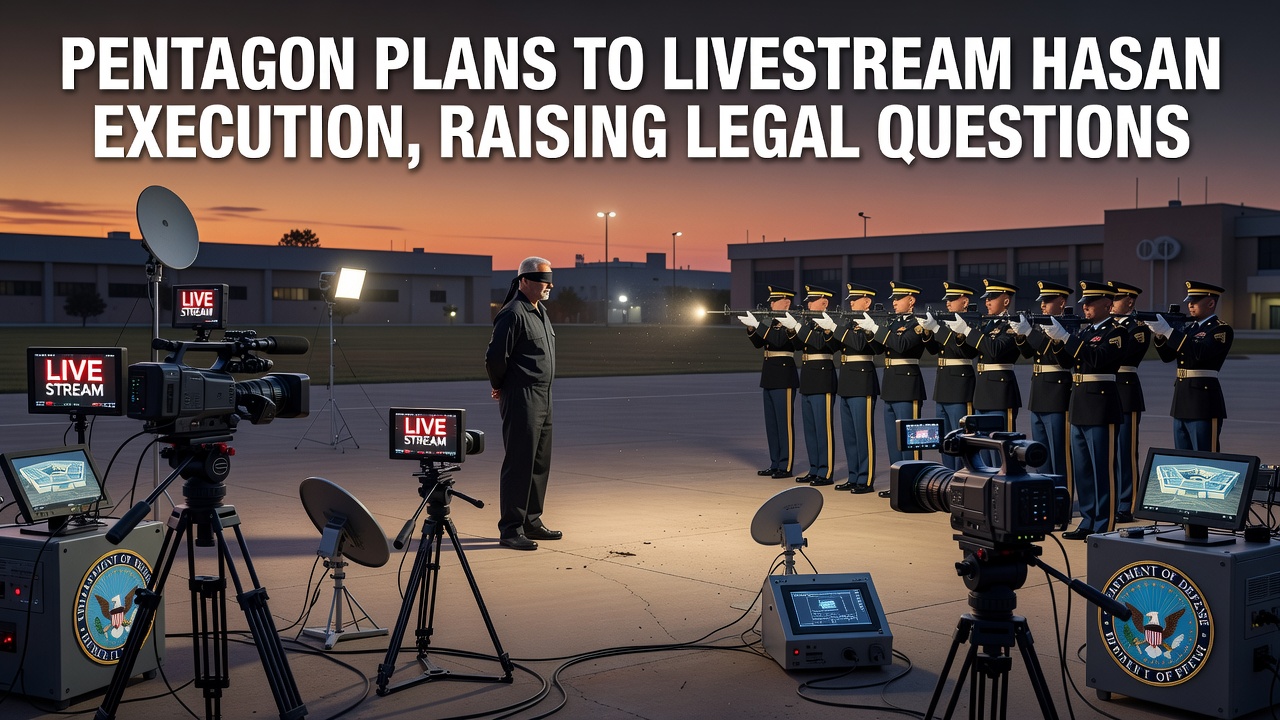
The US Department of Defense has confirmed plans to livestream the execution by firing squad of Nidal Hasan, who killed 13 unarmed soldiers at Fort Hood in 2009. If carried out as described, it would mark the first publicly broadcast execution in the United States in close to a century. The announcement has drawn scrutiny not for the sentence itself, which has stood for more than a decade, but for the method of its disclosure to the public.
Why the method matters as much as the sentence
Executions in the United States have historically been shielded from public view, limited to a small number of official witnesses under conditions set by the relevant jurisdiction. The military justice system operates under its own set of rules, distinct from state and federal civilian procedures, and historically has not broadcast executions to the public. A livestream would represent a significant departure from that precedent, raising questions about who authorized the change, under what legal authority, and what safeguards would govern distribution of the footage.
A patchwork of rules across jurisdictions
Execution protocols in the US are not uniform. States set their own procedures for capital punishment, federal executions follow separate Bureau of Prisons regulations, and military executions fall under yet another framework tied to the Uniform Code of Military Justice. This fragmentation means a practice permitted in one system may be explicitly barred in another.
- State executions typically restrict attendance to a limited list of witnesses, often including victims' families, media representatives, and officials.
- Federal executions follow Bureau of Prisons rules, which have historically excluded broadcast or recording for public distribution.
- Military executions are rare - this would be the first since 1961 - leaving limited precedent for how modern recording and streaming technology should be handled.
Because military executions happen so infrequently, existing regulations were drafted long before livestreaming technology existed, leaving genuine ambiguity about what is and isn't permitted.
The broader implications of broadcasting an execution
Any decision to stream an execution publicly would likely face legal challenges, both from advocacy groups opposed to capital punishment and from those concerned about setting a precedent for how the state handles the most severe form of punishment under its control. Questions would extend to platform responsibility, age restrictions, data retention, and whether footage could be re-distributed or archived once released. These are not hypothetical concerns - they mirror debates that have played out in other contexts involving graphic or sensitive government-sanctioned content made public online.
There is also the matter of institutional transparency versus spectacle. Proponents of openness around state execution have long argued that the public should be able to witness punishments carried out in its name. Critics counter that livestreaming introduces a different dynamic altogether, turning a legal process into content that can be clipped, shared, and consumed outside any controlled setting.
What happens next
Whether the Department of Defense proceeds with a livestream, and whether it would survive legal scrutiny, remains unresolved. Given the rarity of military executions and the absence of modern precedent, any final decision is likely to be contested in court before it reaches implementation, with the outcome shaping how future cases - military or otherwise - are handled in an era where broadcasting almost anything is technically possible.