
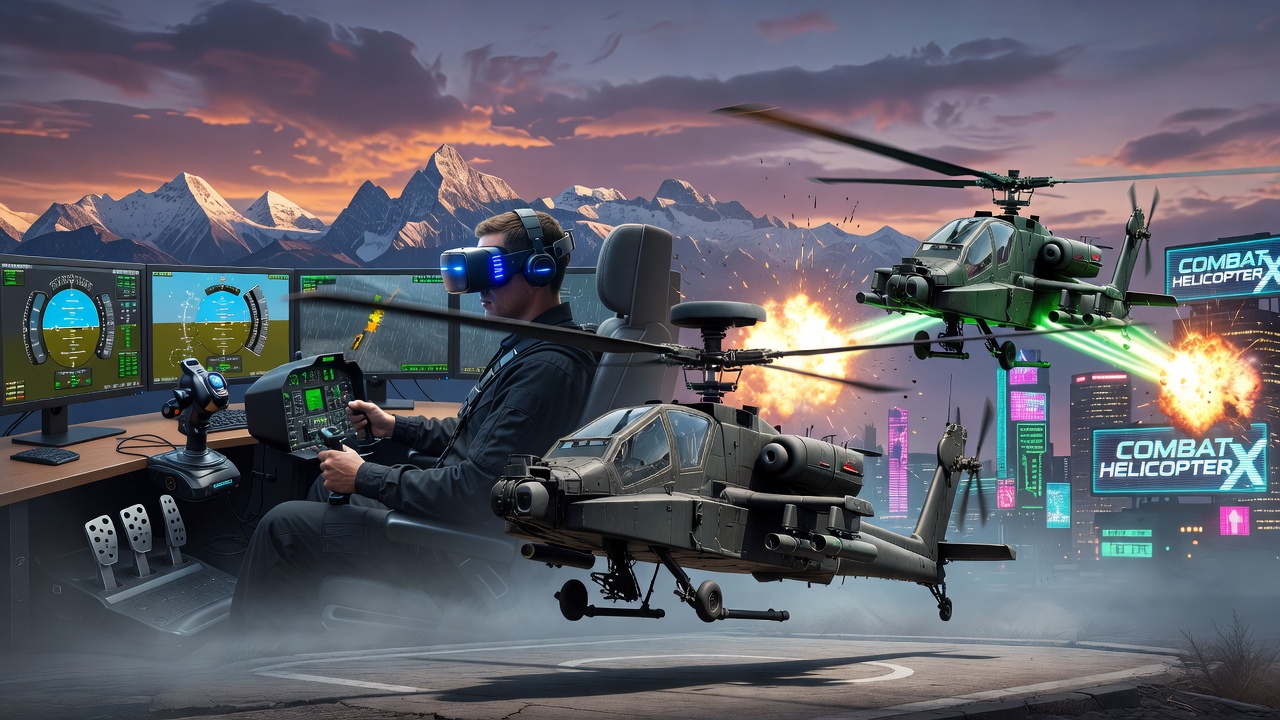
A helicopter has no wings, no fixed lift, no natural tendency to stay in the air. Every second of flight is an argument against gravity, won through a constant balancing act between the collective, the cyclic, and the anti-torque pedals. That mechanical complexity is exactly why helicopters have fascinated game developers for decades - and why so few titles manage to capture them well. Fixed-wing flight can be simplified into a handful of intuitive controls. Rotary-wing flight resists that shortcut.
This resistance is precisely what makes a good helicopter video game so satisfying once it clicks. There's a particular thrill in hovering a virtual aircraft steady over a landing pad for the first time, feeling the machine respond to input rather than fight it. That same appetite for mechanical mastery and adrenaline has spilled into unexpected corners of gaming culture - including the rise of the helicopter x game, a browser-based title at https://playwise365.com/promo/slots/helicopter-x-game/ that translates the tension of ascent and risk into a fast-paced betting format. The crossover says something about how deeply the helicopter, as a symbol of controlled danger, has embedded itself in interactive entertainment.
What follows is a practical map of that landscape: the flight sims built for realism, the arcade shooters built for spectacle, and everything in between. Whether the goal is learning autorotation procedures or simply blowing up a convoy from a gunship cockpit, there's a genre - and a game - suited to it.
Understanding the Helicopter Gaming Genre
Before comparing individual titles, it helps to understand why helicopters occupy such a distinct niche in flight-based entertainment. Unlike airplanes, helicopters can hover, fly backward, and rotate on a fixed point - capabilities that demand entirely different control schemes and, consequently, entirely different design philosophies from developers.
What Makes Helicopter Games Different From Airplane Games
An airplane simulator rewards smooth, forward-committed inputs. A helicopter simulator game punishes hesitation and overcorrection in equal measure. The cyclic stick tilts the rotor disc to move in any direction; the collective changes the pitch of all rotor blades simultaneously to climb or descend; the pedals counteract torque to prevent the fuselage from spinning. Coordinating all three at once, in real time, is the central challenge that separates rotary-wing titles from their fixed-wing cousins.
The Appeal of Vertical Flight and Hovering Mechanics
Hovering is deceptively difficult to model and even harder to master as a player. It's also the single mechanic that gives helicopter games their identity - the ability to stop mid-air, inspect a target, insert troops, or line up a precision strike without the constant forward motion airplanes require. Developers who nail this mechanic tend to produce the most respected titles in the genre.
Casual vs. Realistic Helicopter Experiences
Not every helicopter video game aims for authenticity. Some strip away the complexity entirely, offering arcade-style controls where a single stick handles direction and altitude. Others go the opposite direction, modeling engine failure, blade stall, and ground resonance with academic precision. Recognizing which category a game belongs to before buying it prevents a lot of frustration.
Top Helicopter Flight Simulator Games for Realism
For players who want to understand what actually happens inside a cockpit, realistic simulators remain the gold standard. These titles trade instant gratification for depth, and that trade generally pays off for anyone patient enough to learn the systems.
Best Options for PC Simulation Enthusiasts
PC platforms host the most detailed helicopter simulator game experiences available anywhere, largely because of mod support and compatibility with dedicated flight hardware - collective levers, pedal sets, and force-feedback cyclic sticks. Titles in this space often model specific aircraft down to individual switch functions, appealing to players who treat the hobby closer to a technical study than a pastime.
Console-Friendly Simulators Worth Trying
Consoles historically lagged behind PC in simulation depth, mostly due to controller limitations. That gap has narrowed as developers design control schemes that map complex helicopter behavior onto a standard gamepad without gutting the experience. These versions won't satisfy purists, but they offer a legitimate entry point for players unwilling to invest in specialized hardware.
VR Helicopter Simulators and Immersive Experiences
Virtual reality adds a dimension that flat-screen simulation simply cannot replicate: spatial awareness. Judging altitude, closing distance, and rotor clearance becomes intuitive when depth perception is genuinely present rather than inferred from a 2D display. Several modern helicopter simulator titles now support VR headsets specifically to capitalize on this advantage.
- Hardware compatibility (HOTAS, collective levers, rudder pedals)
- Availability of realistic flight models based on real aircraft
- Weather and time-of-day simulation depth
- Mission editor or free-flight sandbox options
Best Combat Helicopter Games for Action and Strategy
Simulation is only half the story. The other half belongs to combat - gunships, attack helicopters, and the tactical decisions that come with commanding one under fire.
Classic Combat Helicopter Titles That Defined the Genre
Long before modern graphics engines existed, a handful of combat helicopter game titles established the core loop still used today: identify the threat, use terrain for cover, strike, and reposition before return fire arrives. These early titles proved that rotary-wing combat could be just as tactically rich as ground-based shooters, if not more so, given the added dimension of altitude.
Modern Combat Helicopter Games With Advanced Physics
Contemporary titles layer authentic flight physics onto combat scenarios, forcing players to manage fuel, ammunition, and airframe damage simultaneously with enemy positioning. This blend of simulation and warfare produces a steeper learning curve than pure arcade shooters, but the payoff is a far more convincing sense of piloting an actual weapon platform rather than a floating turret.
Multiplayer Combat Helicopter Experiences
Human opponents behave unpredictably in ways scripted enemy AI rarely does, which makes multiplayer combat helicopter modes some of the most replayable content in the genre. Coordinating with a gunner, evading missile locks called out by squadmates, and executing team-based strike runs adds a layer of communication-driven strategy absent from single-player campaigns.
Helicopter X Games and Arcade-Style Entertainment
Not every helicopter experience aims for realism or tactical depth. A growing category treats the helicopter as a vehicle for pure spectacle, speed, and reflex-driven challenge - and the term "x game" has become shorthand for this high-adrenaline, stunt-oriented approach.
What Defines an X-Style Helicopter Game
The "X" branding generally signals extreme difficulty curves, exaggerated physics, and objectives built around risk-reward tension rather than procedural accuracy. Obstacle courses, timed runs, and near-miss scoring systems replace fuel management and instrument checks. It's the same core vehicle, repurposed for a completely different kind of thrill.
Browser-Based and Mobile Helicopter X Game Options
Accessibility is the defining strength of this category. A helicopter x game typically requires no download, no specialized hardware, and no prior flight knowledge - just quick reflexes and a tolerance for repeated failure until the pattern clicks. This lowers the barrier to entry dramatically compared to full simulators, which explains why arcade and betting-adjacent helicopter formats have found an audience well beyond traditional flight-sim enthusiasts.
Why Arcade Helicopter Games Attract a Different Audience
Simulator fans and arcade fans rarely overlap completely, and that's by design. One group wants procedural authenticity; the other wants immediate, visceral feedback. Arcade and X-style titles succeed by removing the learning curve almost entirely, trading depth for instant accessibility - a trade that works particularly well on mobile and browser platforms where session length tends to be short.
Choosing the Right Helicopter Flight Game for Your Skill Level
With the genre split so clearly between realism and arcade spectacle, matching the right title to the right player matters more than it might first appear.
Beginner-Friendly Controls and Assisted Flight Modes
Most modern titles include assisted flight modes that automatically stabilize the aircraft, effectively simulating an autopilot system for hovering and basic maneuvering. This is the correct starting point for anyone new to the genre - disabling assists too early almost guarantees frustration rather than learning.
Intermediate Challenges: Mission-Based Gameplay
Once basic control feels natural, mission-based scenarios introduce constraints: fuel limits, weather, and objective-based scoring. This stage bridges the gap between casual flying and full simulation, and it's where most players decide whether they want to push toward realism or drift toward arcade-style combat instead.
Advanced Simulation for Serious Flight Enthusiasts
At the top end, players disable every assist, fly by instruments alone, and treat failures - engine-outs, mechanical malfunctions, degraded visibility - as core gameplay rather than obstacles to avoid. This tier overlaps heavily with real-world aviation training concepts, which is precisely why flight schools and even military programs have referenced high-fidelity simulators as supplementary training tools.
Frequently Asked Questions
What's the difference between a helicopter simulator game and a combat helicopter game?
A simulator focuses on accurately reproducing flight mechanics, systems management, and real-world procedures, often without combat elements at all. A combat helicopter game adds weapons, enemy AI, and mission objectives, usually simplifying some flight physics to keep the pace fast enough for action gameplay.
Do I need special hardware to play helicopter flight games properly?
No, but dedicated peripherals like a collective lever and rudder pedals significantly improve control precision in realistic titles. Arcade and X-style helicopter games are designed around standard controllers or even a mouse and keyboard, so hardware investment only matters if you're pursuing high-fidelity simulation.
Is a helicopter x game the same as a traditional flight simulator?
No. A helicopter x game prioritizes quick, high-risk, reflex-based sessions rather than procedural flight accuracy, and many versions incorporate betting-style mechanics rather than mission structures. It shares visual and thematic elements with simulators but serves an entirely different kind of entertainment.
Which helicopter video game is best for someone who has never played one before?
Titles offering assisted flight modes and gradual difficulty progression are the safest entry point, since they let newcomers get comfortable with hovering and basic navigation before introducing combat or complex weather systems. Starting with a fully manual simulator almost always leads to early frustration and abandonment.
Are multiplayer combat helicopter games harder than single-player campaigns?
Generally yes, because human opponents adapt their tactics in ways scripted AI doesn't, forcing constant repositioning and communication with teammates. Players usually benefit from completing single-player missions first to build fundamental flight and combat skills before entering multiplayer matches.
Can helicopter flight games actually help someone learn real aviation concepts?
High-fidelity simulators can reinforce genuine principles like torque management, autorotation, and instrument reading, which is why some are used as supplementary training aids. They don't replace certified flight instruction, but they build useful muscle memory and conceptual understanding before a student ever sits in a real cockpit.