
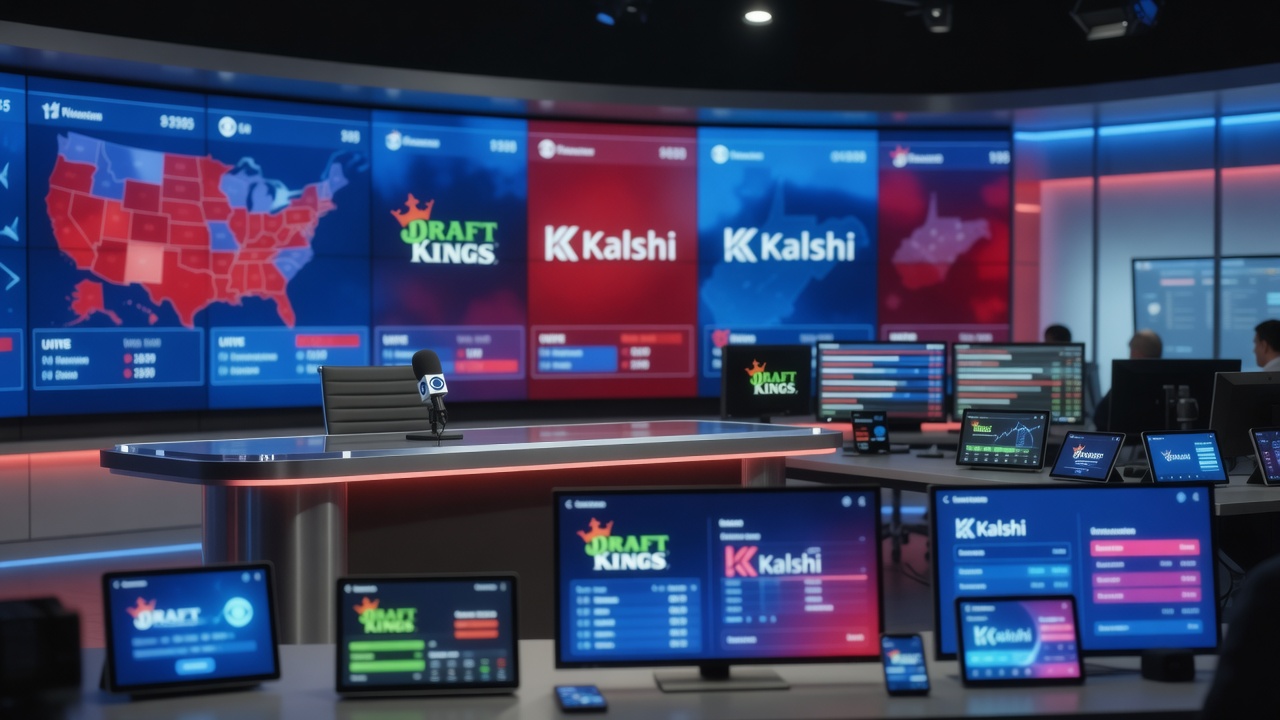
CBS stations around the country learned late last week that their 2026 election night broadcasts would carry sponsorship from DraftKings, a company built on daily fantasy sports and sports betting. The arrangement extends a pattern already underway at the network's national level, where the prediction market Kalshi sponsors CBS News' election coverage. Two different categories of wagering-adjacent companies are now attached to the same network's political programming, at the national and local level respectively.
A Decade-Long Pivot From Fantasy Sports to Elections
DraftKings began as a daily fantasy sports operator, a category that carved out a legal gray zone before most states had sports betting frameworks in place. The 2018 Supreme Court decision striking down the federal ban on state-regulated sports betting opened the door to the company's current business, which spans mobile sportsbooks, iGaming, and now event contracts tied to political outcomes. Election betting itself is not new to the DraftKings story. Back in 2020, DraftKings and BetMGM joined FanDuel in petitioning West Virginia regulators for approval to offer betting on the presidential race. That request was rejected almost immediately, reflecting a long-standing reluctance among regulators to treat elections as a betting product akin to a football game or a horse race.
What has changed since then is the regulatory architecture. Political event contracts, structured through platforms that operate adjacent to or within commodity-trading frameworks, have found a path that traditional sports betting licensing never offered for elections. Kalshi's prominence as a prediction market, and its willingness to list contracts on election outcomes, has forced sportsbooks like DraftKings to find their own foothold in the same space rather than cede it entirely.
Why DraftKings Wants Into Election Coverage
The strategic logic is straightforward. DraftKings cannot offer sports betting or sports-related event contracts in every state; licensing restrictions, legal challenges, and an uncertain regulatory posture toward sports event contracts all complicate that business. Political event contracts offer a parallel market that is not bound by the same state-by-state sports betting licensing regime, giving the company a way to reach users in jurisdictions where its core product is unavailable. Sponsoring local election coverage puts the DraftKings name in front of a television audience that may have no interest in sports betting but tunes in for results on election night, a captive and engaged audience at a moment of genuine civic attention.
Advertising tied to live election results also carries a different tone than a typical sportsbook promotion. It positions the company alongside the apparatus of democratic process rather than alongside the fantasy-football crowd, a reputational move as much as a commercial one.
Regulatory and Consumer Questions Still Unresolved
The legal status of political and sports event contracts remains contested. Courts and the Commodity Futures Trading Commission have not settled whether these products belong under federal commodities oversight or state gambling law, and that question could look very different under a future administration with a different regulatory philosophy. If sports event contracts face tighter restriction, political contracts may become an even more important fallback for operators like DraftKings, intensifying their push into this space regardless of how the courts rule on sports.
For viewers, the practical effect is a blurring of lines between a news broadcast's civic function and a gambling company's marketing reach. That blurring deserves scrutiny independent of whether any individual contract or ad is misleading: association between election reporting and wagering products on elections raises questions about how audiences, including younger and first-time voters watching returns, interpret the line between following democracy and betting on its outcome. Responsible marketing standards that apply to sports betting advertising, age verification, clear disclosure of terms, and avoidance of language implying easy winnings should apply with equal or greater rigor here.
- DraftKings now sponsors CBS' local election night coverage; Kalshi sponsors the network's national coverage.
- Election betting was rejected by West Virginia regulators in 2020 when DraftKings, BetMGM, and FanDuel sought approval.
- Political event contracts currently sit outside traditional state sports betting licensing, giving operators reach in states where sports betting is restricted.
- The CFTC's and courts' treatment of sports and political event contracts remains unresolved and could shift under future administrations.
The next marker to watch is who, if anyone, sponsors coverage of the 2028 presidential debates. If a sportsbook or prediction market lands that role, it will confirm that political event contracts have moved from a regulatory footnote to a fixture of how Americans consume election news.