
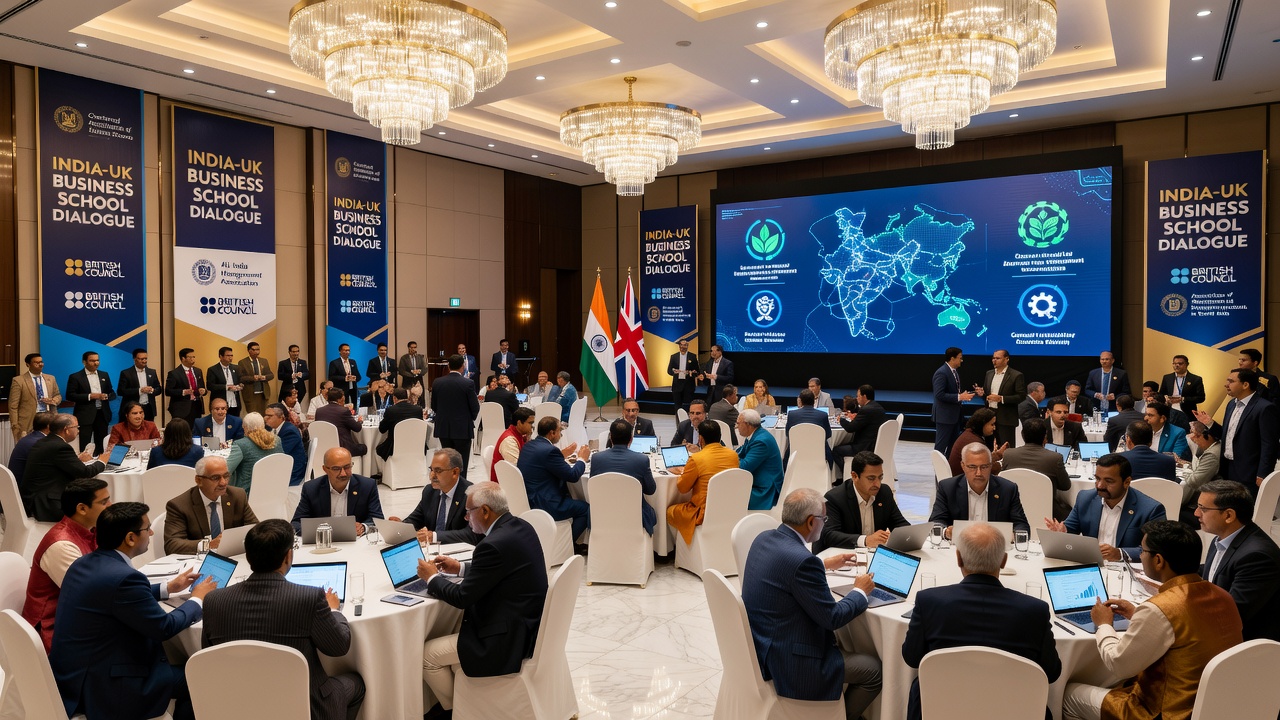
More than one hundred business schools from India and the United Kingdom will gather in New Delhi on 16-17 September 2025 for a forum aimed at deepening institutional cooperation between the two higher-education systems. The India-UK Business School Dialogue brings together deans, academics, government officials, and regulators to discuss how the two countries can build durable partnerships in management education, research, and transnational delivery.
The event is organised by the UK's Chartered Association of Business Schools, with support from the British Council, the All India Management Association, the Association of Management Development Institutions in South Asia, and the India Business Group. The involvement of these bodies signals that the Dialogue is not a one-off networking exercise but part of a sustained effort to align academic cooperation with broader diplomatic and economic goals shared by London and New Delhi.
Why Business Education Has Become a Diplomatic Priority
Higher education has steadily moved from the margins of bilateral relations to their centre. India produces one of the largest cohorts of management graduates in the world, while the UK retains a strong international reputation in business research and pedagogy. As both governments pursue closer trade and investment ties, education has become a practical channel for building long-term people-to-people links that outlast any single trade negotiation. Business schools, in particular, sit at the intersection of commerce, policy, and skills development, making them a natural focus for this kind of institutional diplomacy.
Transnational Education as the Central Theme
A significant part of the Dialogue's agenda concerns transnational education, or TNE - arrangements where a UK institution delivers degrees or joint programmes in India, whether through branch campuses, dual degrees, or online-blended formats. TNE has grown in importance as India has gradually opened its regulatory framework to foreign universities, and as UK institutions look for sustainable ways to engage Indian students without relying solely on recruitment for study in Britain. For both sides, the attraction is practical:
- Indian institutions gain access to international curricula, faculty exchange, and research partnerships without requiring students to relocate.
- UK business schools reach a large domestic market while diversifying their revenue base beyond international student recruitment alone.
- Both systems can test joint research agendas on shared challenges such as sustainability, technology, and governance.
What Is at Stake for Institutions and Students
Partnerships of this kind are not without friction. Quality assurance, degree recognition, and regulatory alignment between two very different higher-education systems require careful negotiation. India's regulatory bodies have been cautious in approving foreign institutional presence, and UK institutions must weigh reputational risk against commercial opportunity when entering joint ventures abroad. For students, the practical value of any agreement will depend on whether qualifications are genuinely recognised by employers and professional bodies in both countries, rather than existing only as an institutional arrangement on paper.
The presence of regulators and policymakers alongside academic leaders at the Dialogue suggests organisers are treating these governance questions as central rather than peripheral. A forum that produces frameworks for accreditation, research funding, and staff mobility will carry more lasting weight than one limited to goodwill statements.
A Test of Follow-Through
The real measure of the Dialogue's success will not be the scale of the gathering itself but what follows it - formal agreements, joint research output, and functioning TNE programmes over the coming years. Bilateral education forums are common; converting them into operational partnerships that survive changes in government policy or institutional leadership is considerably harder. For now, the event represents an attempt to set shared priorities before committing to the harder work of implementation.