
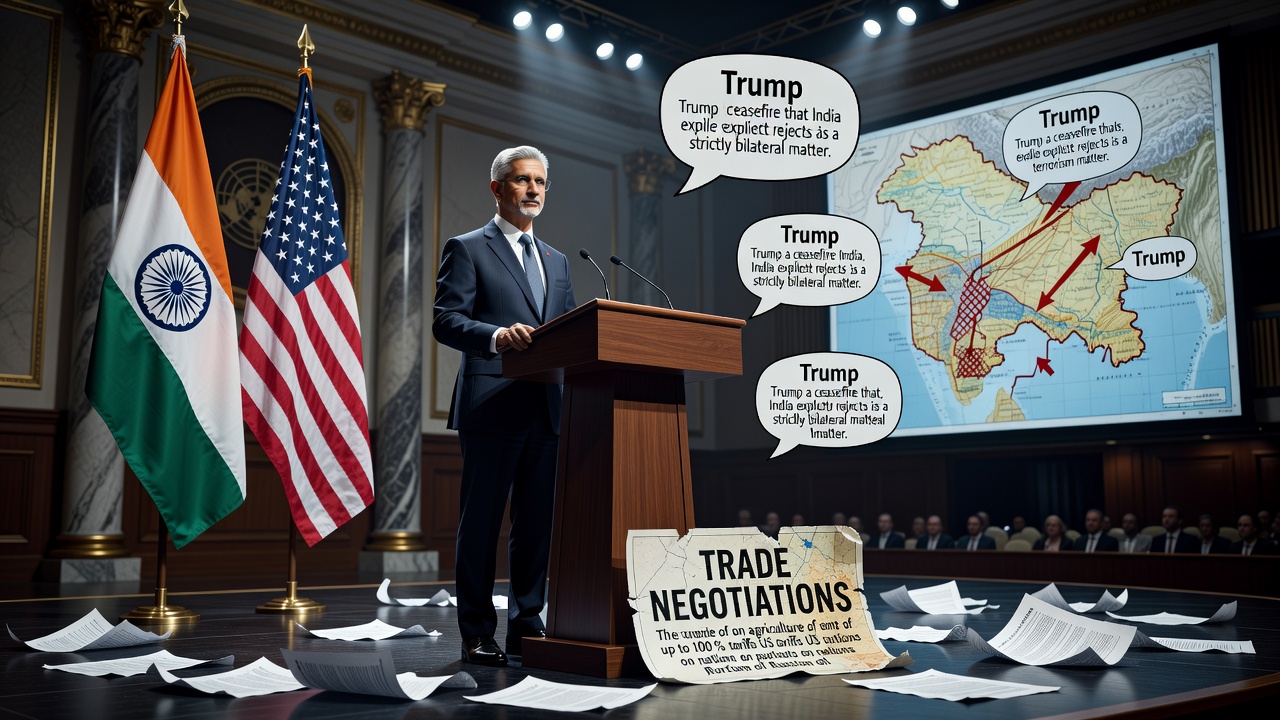
India's foreign minister went further than Indian officials typically allow themselves in public this week, telling an audience in New York that Washington has been an unreliable partner on terrorism, has grown closer to Pakistan, and has pursued trade policies that put its own interests above those of poorer nations. The remarks, delivered after the UN General Assembly session, mark a departure from decades of India handling friction with the United States quietly and privately.
A Relationship Built on Discretion Now Tested in Public
India has long treated its ties with Washington as too valuable to jeopardise through open criticism, even when disagreements ran deep. That restraint reflected a bipartisan American consensus favouring closer relations with New Delhi, and an Indian calculation that quiet diplomacy served its interests better than public confrontation. S Jaishankar's comments suggest that calculus is shifting. Analysts tracking South Asian diplomacy describe the tone as a frank, if uncomfortable, acknowledgement that the relationship has lost momentum since Donald Trump returned to office.
Trade Friction and the Tariff Threat
Trade sits at the centre of the dispute. The United States is India's largest trading partner, and the balance currently favours India by a wide margin, a point that has fuelled Washington's push for concessions, particularly in agriculture. India has protected its farm sector for decades, and Jaishankar acknowledged that expectations of a swift deal collided with that reality. Negotiations have produced a roadmap but no finalised agreement. More pressing is a new US measure allowing tariffs of up to 100 percent on countries purchasing Russian oil, a category that includes India. If implemented, that tariff would represent a serious rupture, and some former diplomats describe it as a potential breaking point for the broader relationship.
Terrorism, Pakistan, and a Sense of Being Overlooked
The second source of tension concerns how Washington has handled the aftermath of last year's brief conflict between India and Pakistan, triggered by an attack in Indian-administered Kashmir. Trump has repeatedly claimed credit for brokering the ceasefire that ended the fighting, a framing India rejects, insisting any dispute with Pakistan remains strictly bilateral. Pakistan's warm public courting of Trump, including a Nobel Peace Prize nomination, has only sharpened India's unease. Jaishankar's remark that India has faced terrorism "as part of a deliberate, conscious policy" from a neighbour, without adequate acknowledgement from Washington, reflects a long-standing grievance that predates the current administration but has intensified under it.
Domestic Politics Behind the Shift in Tone
Changes in US visa policy, particularly tighter rules and higher costs tied to the H-1B programme heavily used by Indian professionals, have added a domestic political dimension. Narendr Modi faces state elections next year and growing opposition criticism that his government has been too accommodating toward Washington. Public sentiment in India toward the United States appears to be cooling, and officials seem increasingly willing to voice frustrations that were previously confined to closed-door negotiations.
What Comes Next
Despite the sharper rhetoric, neither side has abandoned the relationship. Jaishankar himself noted that India's difficulties with Washington are not unique, framing them as symptomatic of an unpredictable and transactional US foreign policy under Trump rather than a targeted rebuff of India. That framing leaves room for a reset, with a finalised trade agreement widely seen as the clearest marker of whether ties can stabilise. For now, the prevailing view among observers in New Delhi is less about resolution than endurance: managing an unpredictable Washington until the political weather changes.