
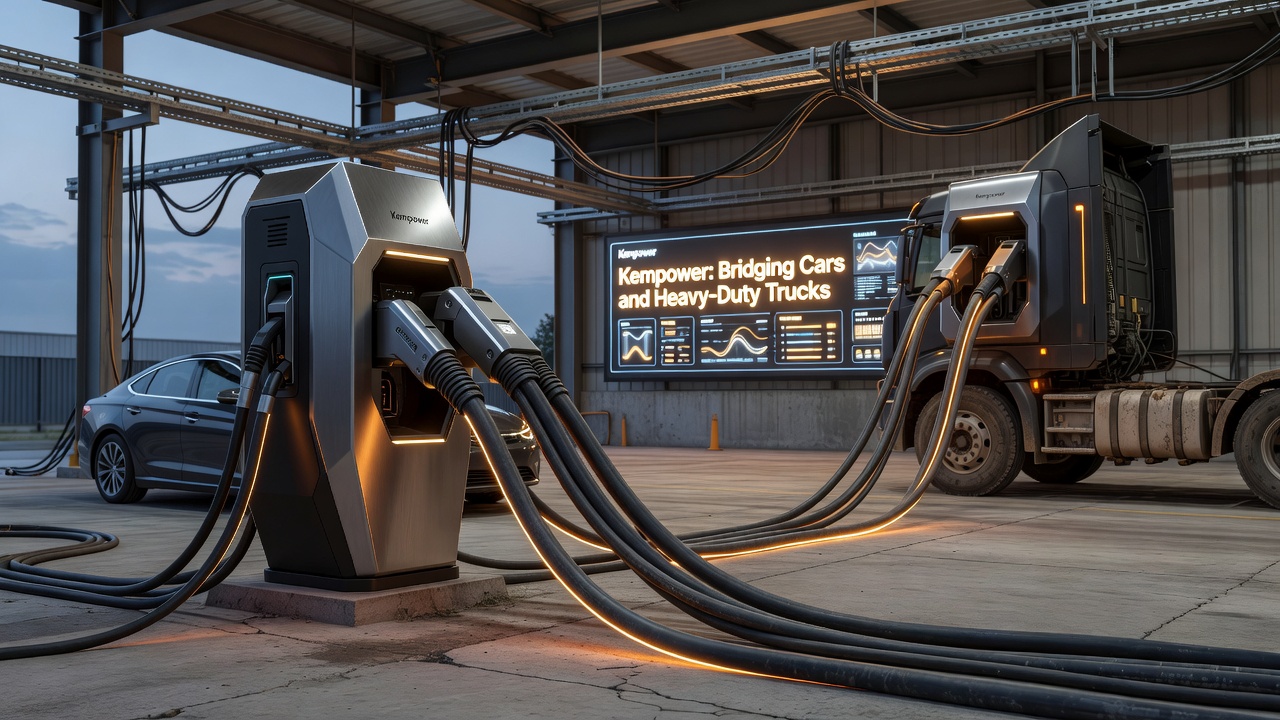
Kempower has introduced the Mega Satellite Flex, a charging dispenser built to handle both the CCS standard already common on passenger EVs and the emerging Megawatt Charging System designed for electric trucks. It is the Finnish company's first unit capable of switching between the two, a distinction that matters as the charging industry works through a delicate transition between established and next-generation standards.
The timing is not incidental. CCS remains the dominant connector for electric cars across North America and Europe, while MCS is only now being deployed at scale to meet the far higher power demands of freight trucks, which need to recharge large battery packs quickly to stay economically viable on long routes. Rather than forcing site operators to choose one standard or build redundant infrastructure later, Kempower's approach lets a single dispenser serve both vehicle classes from the outset. Fleet software and monitoring platforms that manage these sites increasingly need cross-platform flexibility too, much as remote workers rely on tools such as a dedicated Linux client to keep operations running smoothly across different systems without friction. a dedicated Linux client
Technical Specifications and Design Logic
The Mega Satellite Flex delivers up to 560 kW through CCS and up to 1.2 MW through MCS, drawing on current ratings of 700 amps and 1,500 amps respectively. Cable lengths are set at 5 meters for CCS and 2.7 meters for MCS, dimensions chosen to accommodate the physical realities of servicing both compact passenger vehicles and larger truck cabs at the same location. An optional payment terminal allows the unit to function as a public-facing charge point rather than one restricted to fleet accounts.
The dispenser also supports 800-volt vehicle architectures, an increasingly common feature in newer EV models that allows for faster charging without proportionally higher current. That compatibility positions the hardware to remain relevant as automakers continue shifting toward higher-voltage platforms industry-wide.
Why Shared Infrastructure Matters
For charging site operators, the economics are straightforward. Idle hardware is wasted capital, and building separate CCS and MCS installations doubles both upfront cost and physical footprint. A dispenser that serves both vehicle types from day one increases utilization rates immediately, which shortens the payback period on what remains an expensive piece of infrastructure. Kempower has also designed the Mega Satellite Flex to integrate with its existing distributed charging architecture, meaning operators who already run Kempower systems can add the new unit without reworking power cabinets or site wiring.
Market Context and Rollout
Kempower unveiled the charger at its Unplug & Recharge event held alongside ACT Expo, a gathering focused on commercial and clean transportation technology. The company says the Mega Satellite Flex will become commercially available in North America and Europe in July 2026, giving operators a defined window to plan deployments as MCS-compatible trucks reach broader production. The rollout timeline also reflects the broader reality that megawatt charging infrastructure is still catching up to vehicle development, and dual-standard hardware like this may prove a practical bridge until MCS achieves the kind of ubiquity CCS enjoys today.