
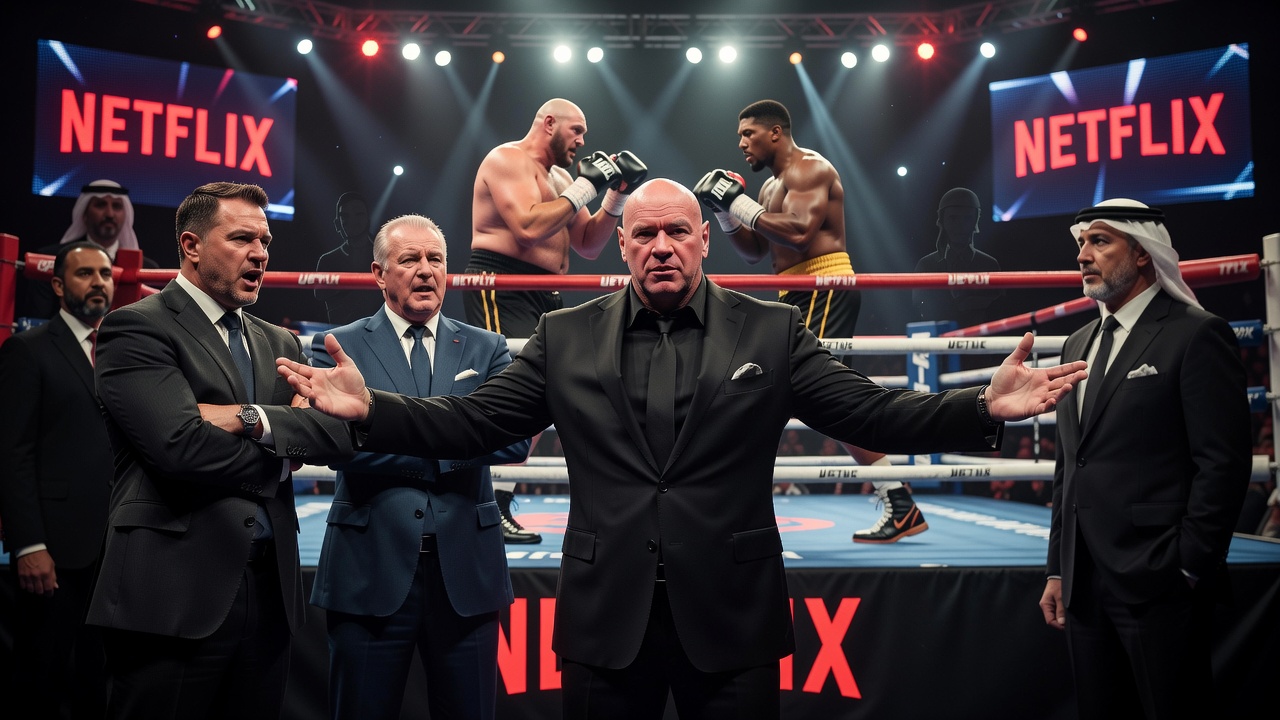
A public disagreement between two of boxing and combat sports' most visible executives has spilled into the open ahead of one of the year's biggest heavyweight fights. Dana White, the longtime UFC president and newly installed Zuffa Boxing chief, confirmed this week that his organization remains central to the production of Tyson Fury vs. Anthony Joshua, even after skipping the London press conference that formally launched the bout. His absence had prompted promoter Eddie Hearn to declare the entire venture a public-relations misstep for White's camp.
A Dispute Rooted in Who Actually Runs the Show
The friction centers on control rather than optics alone. Hearn and Frank Warren remain the promoters of record for their respective fighters, a structure typical in boxing where rival promotional companies negotiate a shared event rather than operating under one banner. White's position is different: he says UFC's production arm will handle the broadcast itself, a function distinct from promotion but arguably more consequential for how the fight is packaged and delivered to viewers. That distinction matters in an industry where promoters often clash over billing, revenue splits, and creative control even when a fight is already signed.
Streaming Platforms Are Reshaping Combat Sports Distribution
The fight's placement on Netflix on Dec. 11 reflects a broader shift already visible across the gaming and entertainment sector, where major streaming platforms are investing directly in live sports programming rather than licensing it from traditional broadcasters. Netflix's involvement, paired with backing from Saudi-linked financier Turki Alalshikh, signals how boxing's biggest cards increasingly depend on capital and infrastructure from outside the sport's traditional promotional ecosystem. For UFC, whose production capabilities are well established through years of pay-per-view and streaming deals, taking on the technical production of a boxing event extends its commercial footprint well beyond mixed martial arts.
Why the Disagreement Matters Beyond Personalities
Public disputes between executives are common in boxing, a sport historically defined by fragmented promotional interests rather than a single governing commercial structure. But this particular clash illustrates a more consequential trend: as combat sports attract outside investment from streaming companies and sovereign-backed financiers, the lines between promoter, broadcaster, and production partner are blurring. That has implications for transparency around how fights are marketed, how revenue is structured, and how audiences are informed about who is actually responsible for what they are watching. For viewers and bettors following the build-up to a high-profile heavyweight fight, understanding these overlapping roles offers useful context - not for predicting outcomes, but for recognizing how modern combat sports events are financed and controlled behind the scenes.